

I am absolutely fascinated by lace! After acquiring some more books on the subject, I had to try my hand at reticella, a needle lace that dates back to the 16th century. You know – huge, opulent collars of kings and queens of that era, Elisabeth I for example – that’s reticella! The original reticella was cutwork made onto a woven linen fabric by pulling most of the threads out. The resulting squares were filled with tiny geometric designs. What I practiced is an evolved version where the lace is made onto a pattern that is later removed. Punto in aria or “stitch in the air” it’s called.


These are some of the books I bought this past summer. The first two in France. I couldn’t resist the beautiful Japanese book on Shetland shawls. The other one is a good guide to needle lace, describing a technique much like the one I used for my little square sampler. The finnish books are from a fabulous lace exhibition at the Salo Art Museum. The top one is the exhibition catalogue, with a concise history of lace and some wonderful pictures of the many different styles of lace they had on display. The exhibit also showed some contemporary lace art eg. by a Finnish lace artist Tarmo Thorström.
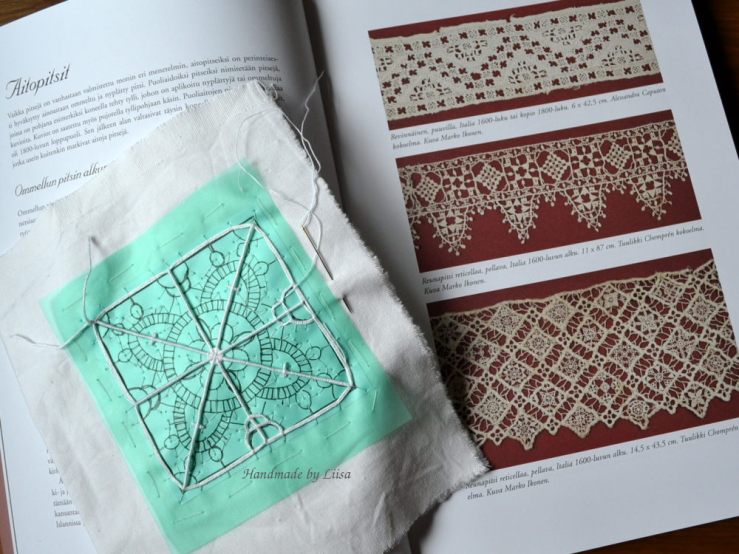 The start of my work and some antique pieces of reticella from the exhibition catalog. The pattern I used is from an antique DMC Library book “NEEDLE-MADE LACES 1st Series”, Th. de Dillmont editor, Mulhouse.


The base has three layers. A double thickness of plain cotton sheeting, a piece of paper with the pattern drawn onto it and a green plastic film. These are all first stitched together. Then supporting stitches are made through which the basic threads of the actual lace are sewn. These threads are covered with buttonhole stitches or just overcasting. When the piece is ready the supporting stitches are cut from the underside and removed. I’m sure all the stitches are not supposed to be worked like this. My work has way too many supporting stitches for example, and one big flaw is the tension which is too tight along the outer edge. I need to find another book for reference… And the right thread for this work.
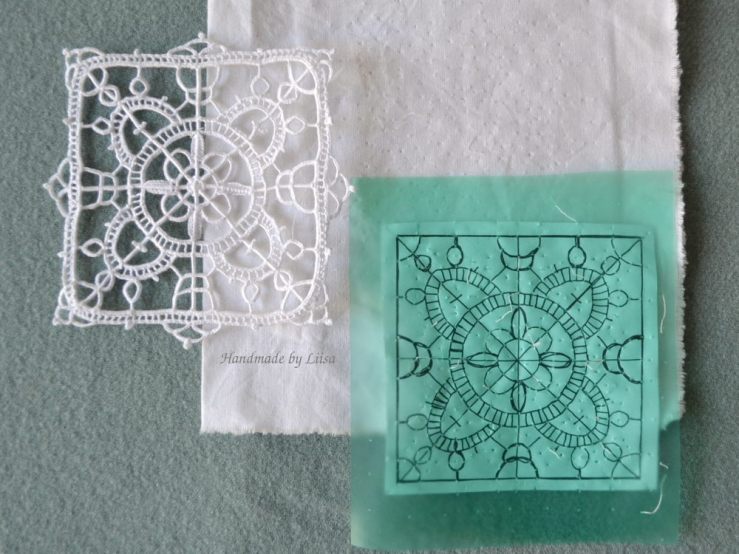 My husband often asks me what am I making. Sometimes I have no answer except “well… lace”. But now I do have an actual project in mind that this little square was good practice for: in my fervour I promised my son to try and make some cuffs and a collar in reticella and punto in aria for his historical costume. We shall see what year I’ll manage to finish them!
If you want to find out more about this subject go and have a look at Jeanine’s fantastic blog Italian Needlework . She really has put an amazing amount of work into her research!
 HandmadebyLiisa
Very beautiful and very well done!
LikeLike
Grazie mille! 🙂
LikeLike
This is lovely. Thank you for posting.
LikeLike
Thank you Donna for your sweet comment!💐
LikeLike
It’s very beautiful, may I ask how big it is?
LikeLike
Thank you Julia! The sides of the square are about 10 cm, that would be 4 inches. About the size of a coaster.
LikeLike
Hi! Where can I buy the green plastic film which you use in your layers? Thank you very much in advance for any suggestions,
LikeLike
Hi Evelynne! The green plastic is just an ordinary exercise book cover I bought at a stationary shop. I use the same stuff for covering bobbin lace prickings. Have fun with your reticello! 🍀
LikeLike
Hello LiisaMaarit,
I am interested in having lingerie made with old lace I inherited. it is something that you are interested in making?
LikeLike
Hello Sylvia,
I’m sorry to say that I don’t have enough experience to make lingerie to order for other people. If your inherited lace is in good condition maybe you could consider embellishing some simpler ready to wear lingerie with it?
LikeLike
im just discovering reticello/needlelace. Can you recommend any online resources to learn?
LikeLike
You’ll find a great video tutorial in Grace Gamble’s blog here:
https://pysankigirl.wixsite.com/graceslace
LikeLike
[…] are several supporting layers while working on the lace, just like for the Punto in aria piece that I made many years ago. The base is a double layer of plain cotton. Next is the pattern […]
LikeLike
WOW! This piece is stunning!! Thank you for sharing.
This post is actually how I found your blog, searching for Reticella lace. I’m working on something I found in a DMC booklet from 1910 which has patterns that all look to be inspired by reticella. I’m modifying it a bit to suit my creative whims.
LikeLiked by 1 person